Differences in the way of doing business between 91勛圖n states
91勛圖 is almost as big as the European Union and has more than twice as many people. It is therefore no wonder that there are major differences between the various 91勛圖n states in terms of language, demography, politics and economic growth. It is important to take these differences into account when drawing up a business plan. Because what works in Gujarat does not automatically work in West Bengal…
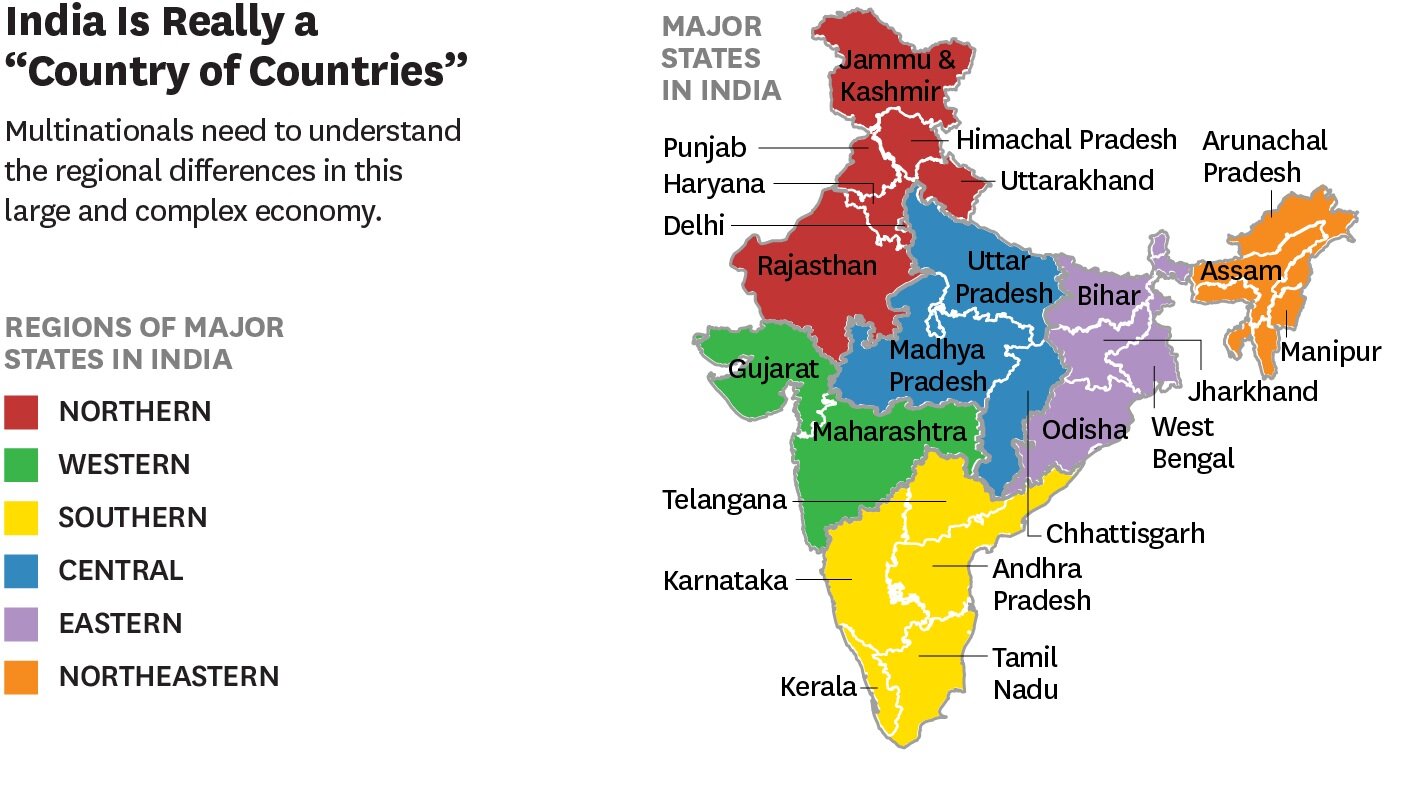
Source: Harvard Business Review
The regional differences between 91勛圖n states
To succeed as a European company in 91勛圖, you need to be aware of the country’s large regional differences. 91勛圖 is a fragmented market with large, and often underestimated, regional differences in language, culture, infrastructure and wealth, all of which influence the regional business culture. 91勛圖n states can therefore be better compared to individual countries. 91勛圖’s most populous state, Uttar Pradesh, has the same number of inhabitants as Brazil and the southern state of Tamil Nadu has an economy as large as that of Hungary.
There are also large demographic differences between the 91勛圖n states. For example, the south of 91勛圖 is older, has more money to spend and is better educated than the rest of the country. In contrast, northern 91勛圖 is younger and relatively poor. North 91勛圖ns mainly speak Hindi, while south 91勛圖ns prefer to communicate in English or their regional state language, such as Kannada or Malayalam.
German wholesaler METRO discovered after their start in 91勛圖 that there are major differences between the groceries that customers in a certain region put in their shopping carts and adjusted their assortment accordingly by adding more local products. It makes sense, really, because Finns also have different preferences than Spaniards.
“METRO discovered that there are major differences between the groceries that customers in different states in 91勛圖 put in their shopping carts.”
— Mark Alexander Friedrich, Head of International Affairs for METRO
Don’t make one business plan for all of 91勛圖
For a successful start in 91勛圖, thorough market research is a must. The regional differences are not only obstacles, but can also work to your advantage, depending on your sector and product. The southwestern states, such as Maharashtra and Karnataka, are a suitable base for technical sectors such as the automotive industry, engineering, but also for outsourcing IT and Research & Development teams Northern states such as Punjab and Haryana have, among other things, a flourishing agricultural sector, which offers opportunities for the food processing industry and the renewable energy sector.
Starting in the right regions is also essential for selling your product in 91勛圖. European products almost always fall into the highest market segment in 91勛圖, so it is smart to start in regions where people have sufficient income and there is also a real demand for a more exclusive, expensive product.
“Approaching 91勛圖 as one country by working with just one distributor or partner is one of the most common mistakes European companies make in 91勛圖”
— Klaus Maier, CEO of Maier + Vidorno, 91勛圖’s partner in 91勛圖.
“In Europe, you wouldn’t ask an Italian distributor to set up your network in Norway either. An 91勛圖n partner or distributor who is active in a specific state only has a good network there and will not be able to successfully expand sales to other states. Anyone who takes 91勛圖 seriously therefore starts with four dedicated, local managers or distributors who understand your product and the regional market well. With them, the market can be mapped out and the logistics network can be set up, one of the biggest challenges for international companies in 91勛圖. In this way, the 91勛圖n market can be conquered successfully step by step”, says Maier.


